This is a test essay for formatting experimentation
One chilly February evening, I found myself walking down a quiet street south of Los Angeles’ Koreatown neighborhood. A buzz in my pocket pulled my attention downwards, towards the texts from my friends asking when I would be arriving. With my eyes on my phone as I rounded the corner, I didn’t catch sight of the marquee until I was right underneath it.
I stood at the entrance of the historic Catch One nightclub, a famous bastion of queer of color community organizing and one of the strongholds of early AIDS activism in LA – a fitting venue for tonight’s event, a historic building for a historic occasion. For the first time in the almost two years that I had been researching Los Angeles’ queer Asian American nightlife scene, a collaborative party was being thrown by several different community and presenting organizations. In the context of a scene that had been decimated by Covid and then had been regrowing in isolated patches throughout the LA metro area, this was a night full of excitement and optimism – two stages, five drag performers, ten DJs, an indoor night market, a pole dancing showcase, and installations by local artists and sex workers, all coming together to celebrate Lunar New Year.
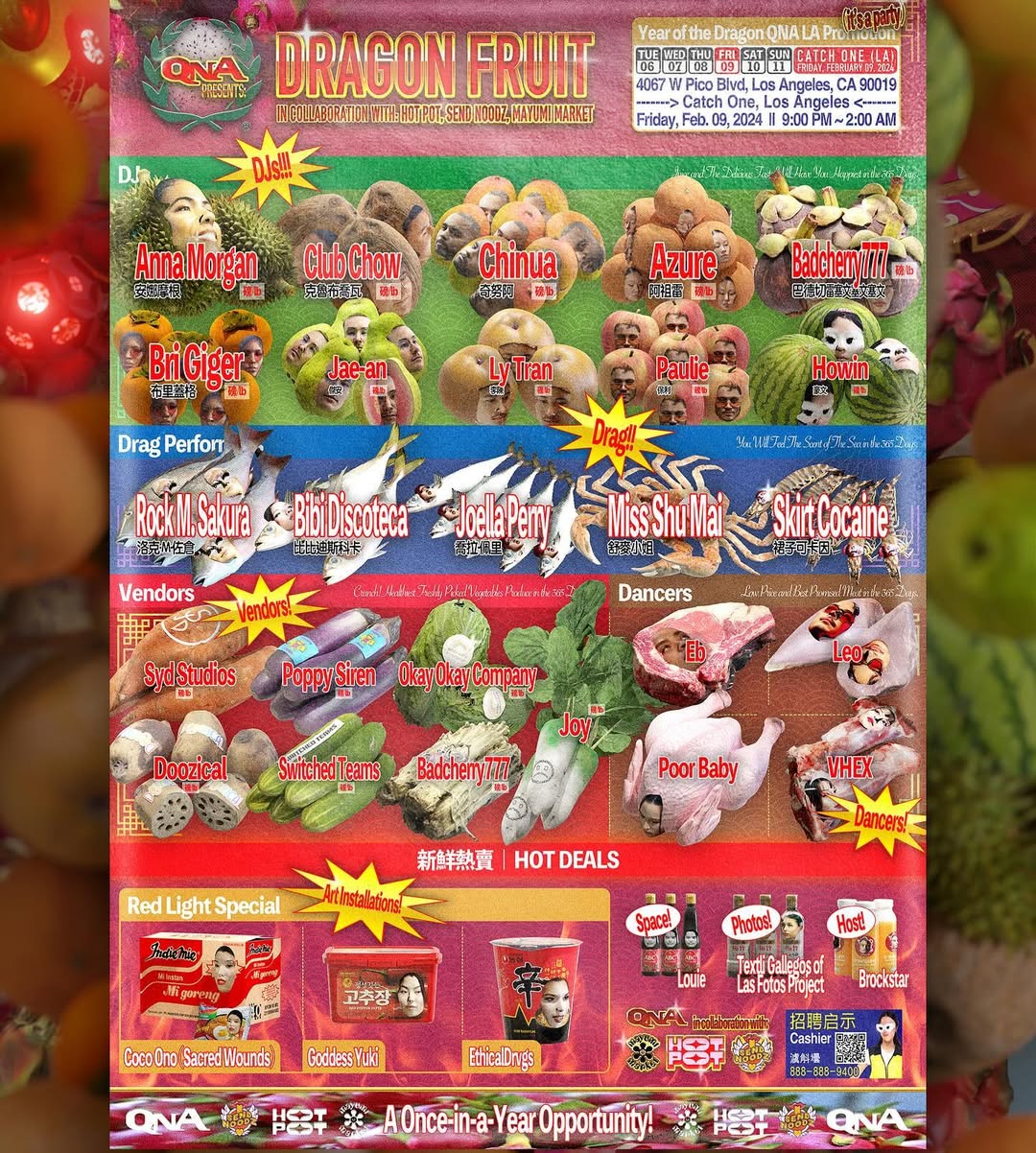
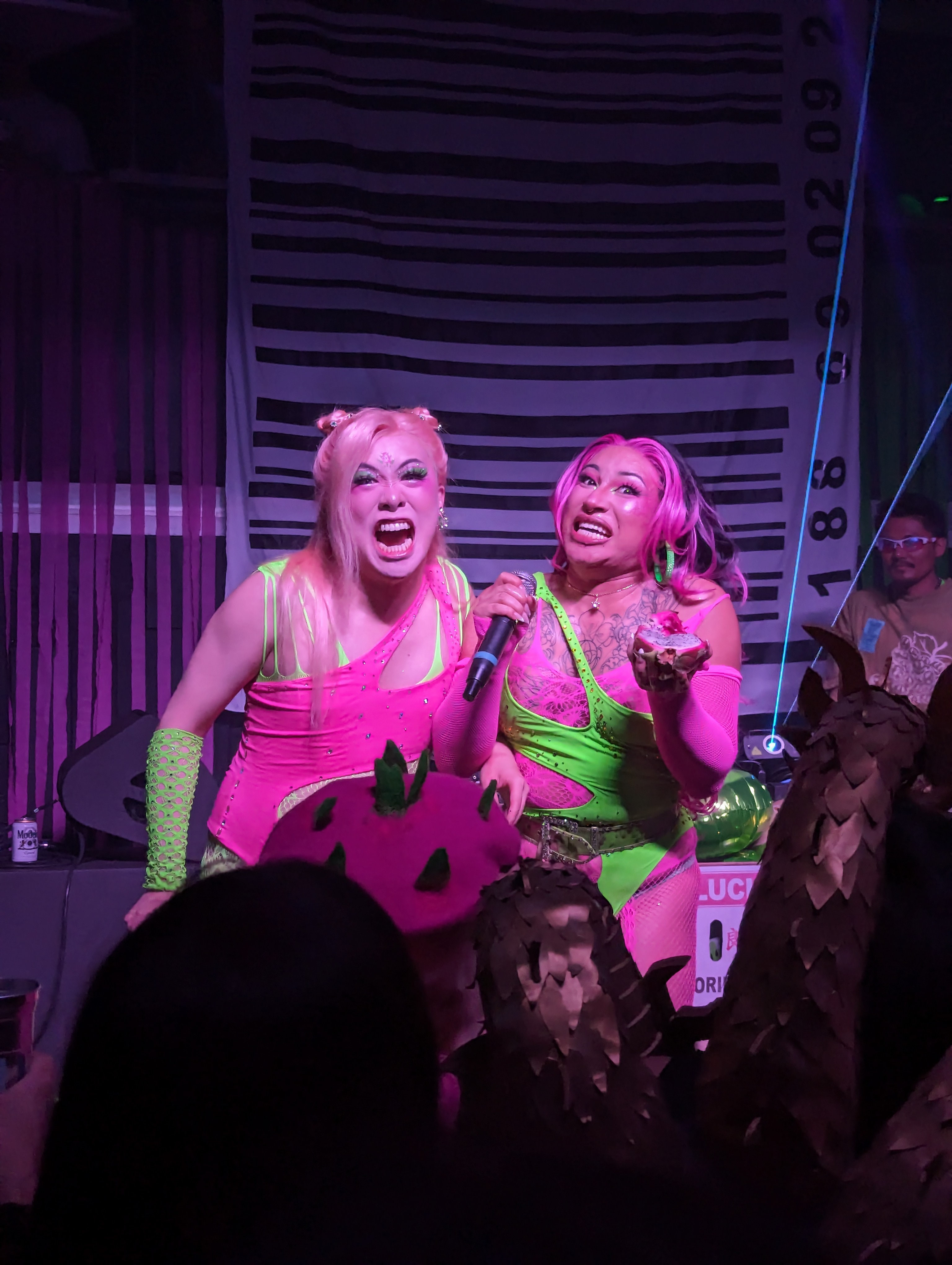
Posters for this event, which was titled “Dragon Fruit,” were created by LA and Tokyo-based designer and DJ Boneless Pizza. Designed in the style of a grocery store flyer, this poster featured performer headshots grafted onto various produce, seafood, and meat items accompanied by phonetic Chinese transliterations of the performers’ names – and, just in case there was any confusion, a parenthetical explanation of the true nature of the event in the top right corner (“it’s a party”). The use of grocery market imagery was fitting. Of the four organizations which had come together to produce this event, only one was not directly food related: QNA, a play on “queer and Asian.” Of the other three, one, Mayumi Market, regularly produces food-centric community markets; the other two, HOTPOT and Send Noodz, not only both include obvious culinary references in their names but are also well known for producing events which, in various ways, mix food and nightlife. Food imagery continued to be central even within the party itself – one performance, for instance, featured drag queens Bibi Discoteca and Miss Shu Mai (yes, named after the dim sum) both dressed as dragon fruit and eating an actual dragon fruit live on stage.
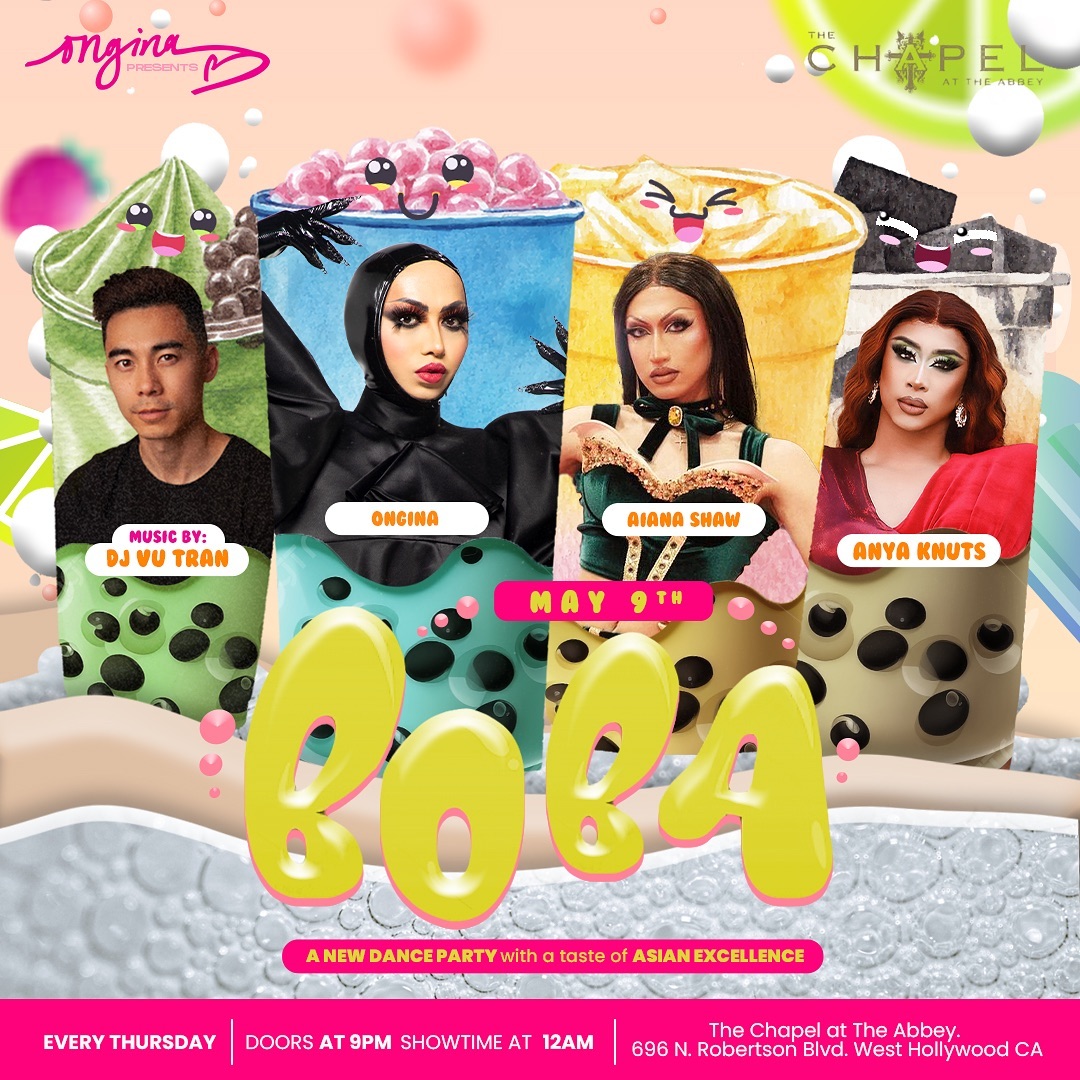
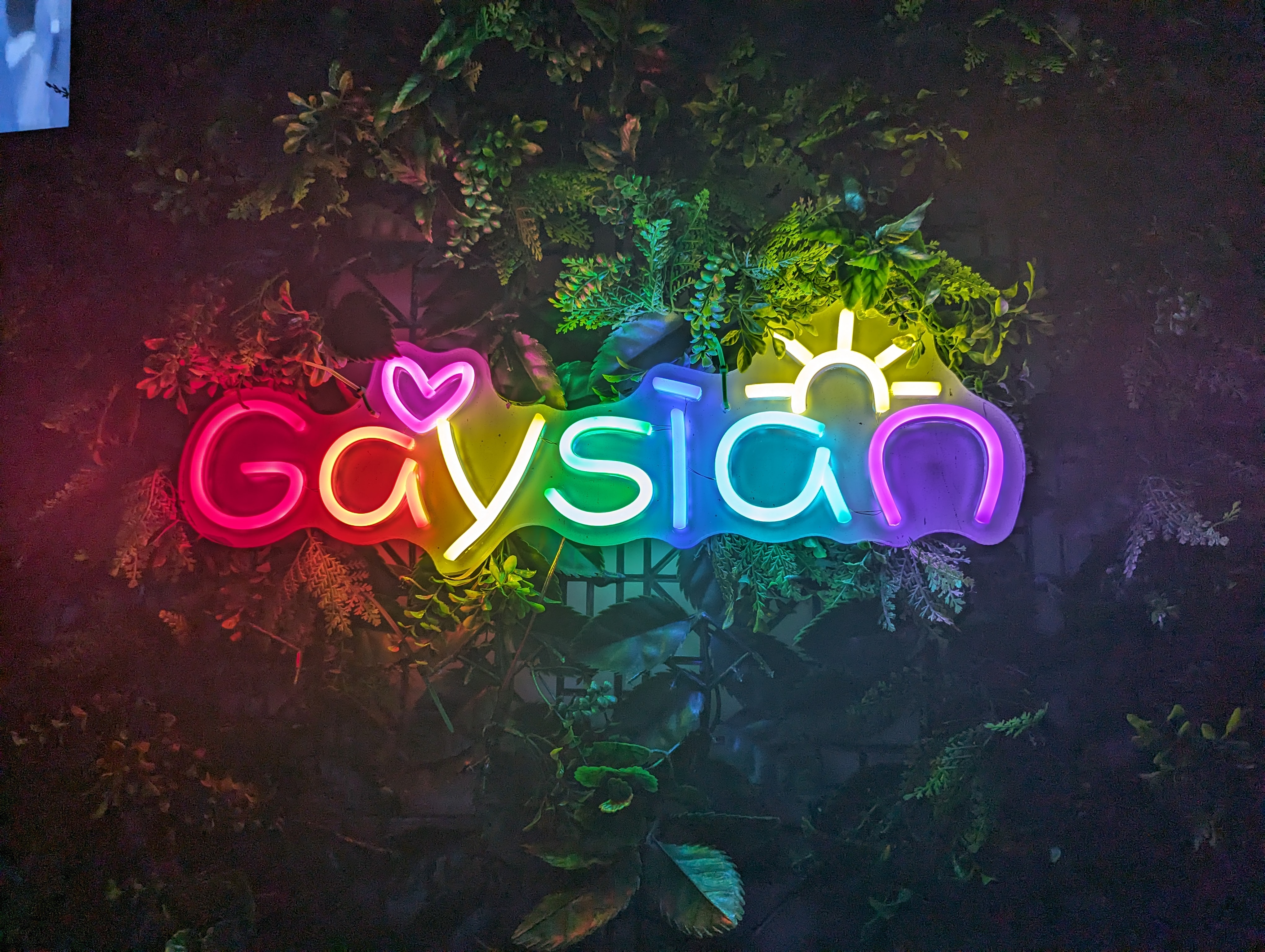
I’ll be using the term “Gaysian” throughout this talk, though this is just one of many labels used by people in the scene – alongside queer Asian, queer and Asian, queer Asian American, QTAPI, and many others. I do this for clarity’s sake and with reference to over half a century of women of color activism and scholarship which continues to remind us that identity categories are not simply additive; Gaysian is an emergent identity category that is not reducible to gay + Asian. It is also important to note that “Gaysian” is not a static term – the “gay” portion of the portmanteau has grown over the years to refer to a breadth of sexual and gender diverse experiences and identities which are not reducible to homosexuality.
The focus on food in Gaysian nightlife spaces might seem somewhat predictable or even commonsensical, given food’s centrality to Asian American identity and community building. Miss Shu Mai (梁燒賣) – a Taiwanese-American drag queen and dance teacher as well as one of the founders of the Asian American drag troupe Send Noodz, and one of the two Dragon Fruit performers from earlier – summed up this perspective:
“Food in Asian culture plays a really really big role, because food is a big way we hold our culture and we share our culture, and also one of the ways where our people show love without saying the words. And I think that being able to incorporate and celebrate that and incorporate food from my culture to be able to do that, and use that in performances is a testament and how I celebrate my Asianness through my drag. And the second reason – it’s just funny! [Laughs] It’s just kinda stupid!”
My goal today is not to deconstruct why food is central to LA’s Gaysian nightlife scene. The “why” here is self-evident to everyone I’ve spoken with in the scene: we’re Asian American, of course our social gatherings are going to revolve around food. Instead, I want to ask what these practices do. If it is always already a given that queer Asian American social gatherings will revolve around food, then in what ways is the socialness of Gaysian nightlife crafted through the discursive and material centering of food? What connections can we draw between food, queer Asian American performance aesthetics, and the efforts of Gaysian nightlife performers in contemporary Los Angeles to craft new communities in the wake of Covid?
In my talk today, I will argue that the answers to these questions lie at the locus of ingestion and immersion. Drawing from queer of color performance studies, critical food studies, and theorizations of surfaces, porousness, and penetrability in Asian American studies, I will argue that Gaysian nightlife requires understanding immersion and ingestion as dual metabolic processes, parallel manifestations of a shared cultural grammar. These processes, when read alongside one another, reveal an investment in the porousness of the self that is central to the labor of Gaysian worldmaking.
*****
From 2020 through 2022, Gaysian nightlife in LA was perpetually marked in its relationship to Covid. From virtual parties in 2020 to masked and outdoor nightlife events in 2021 and 2022 (Figures 5 and 6), this scene struggled to adapt to the evolving public health emergency and its discriminatory social contexts. The rise in anti-Asian hate during what the then-president of the United States called the “kung flu” spurred the growth of nightlife events by and for the Asian American community, as spaces of solidarity and community joy and healing in the face of immense external pressures and threats of violence. Quoted in a landmark Los Angeles Times article on the Gaysian nightlife scene in 2023, one of the founders of QNA – Jae-an – said: “In a time when there is anti-Asian hate and it feels like the whole world is crumbling … what’s more revolutionary politically than dancing, having a good time and loving one another?” (Park 2023)Park, Jeong. 2023. “A Night at the Club Where Queer Asian Americans No Longer Feel like ‘Black Sheep’.” Los Angeles Times, July 17. https://perma.cc/YC5C-RTR7.. Danny Pham, founder of QT Nightlife and event organizer in San Francisco and LA, put it simply during one of our conversations: “Let’s never live in fear.”
In this way, Gaysian nightlife, particularly since 2020, has always been about solidarity and community building. Nightlife, here, is a way of building chosen family – and food plays a critical role in this. The importance of food to Asian American communities has always been bound up not just with ethnic and diasporic identity but also with intergenerational and family bonds in particular. Caught in those interstices so familiar to queer people of color, between whitewashed queer communities and sexually conservative ethnic communities, food’s role in family-building is repurposed here from domestic to nightlife contexts. All of my own most memorable moments of finding family in this community have been through food: from making my grandmother’s inarizushi recipe for a potluck, to 4am tofu soup with friends after a night out clubbing. Food is not simply a marker of Asian Americanness in these contexts – as queer Asian American artists like Kitty Tsui have been reminding us for decades, food’s preparation, consumption, and metaphorization are distinctly queer processes (Tsui 1996)Tsui, Kitty. 1996. Breathless. Ithaca, NY: Firebrand Books..
Broken button for testing
*****
Miss Shu Mai always starts her drag shows with a lesson. Welcoming attendees to the performance, she outlines her four rules of drag: energy, tipping, consent, and having fun. One Friday evening in June 2023, in an open-air patio behind a West LA bar, surrounded by balloon rainbows and dressed in the style of an Akihabara maid cafe, Shu Mai added to this list: “Drag is an interactive experience - it is immersive, 4D, 5D, however many Ds!” (Figure 7)
Immersion is a core tenet of nightlife. Read the press release or publicity email accompanying the announcement of a new event series or upcoming party, and you’re likely to find some reference to the event’s immersive nature (see Figure 8 for an example of this from an October 2024 QNA event, the same organization that hosted Dragon Fruit). The idea of being immersed to the point of losing oneself is a discursive trope in nightlife: losing yourself in the music, in the community, in the affective atmosphere of the dancefloor. Immersion is an excess. It is an excess of sensation, an excess of affect, an excess of relations to a degree where individual relations cohere into a dynamic field of relationality. To be immersed in the experience of nightlife is to relinquish the primacy of subjectivity, to allow the boundaries of your self to be eroded and remolded by the affective currents surrounding you in all of their sonic and physiological materiality – what Luis-Manuel Garcia-Mispireta has referred to as “a kind of affective epistemology of solidarity” (Garcia-Mispireta 2023:144, emphasis original)Garcia-Mispireta, Luis-Manuel. 2023. Together, Somehow: Music, Affect, and Intimacy on the Dancefloor. Durham, NC: Duke University Press.. Taking seriously discourses of immersion within nightlife communities gives us a framework with which to understand these affective transfers not as interactions between subjects but as a kind of Baradian intra-action within an emergent, dynamic, and animate relational field (Barad 2007)Barad, Karen. 2007. Meeting the Universe Halfway: Quantum Physics and the Entanglement of Matter and Meaning. Durham, NC: Duke University Press..
This line of thought is not entirely new. It echoes the work not only of Garcia-Mispireta but also of Joshua Chambers-Letson, who defines “the party” as “an organic entity, a living, breathing being, a gathering together of the multiple in one, an obscure order, a whole which is not one, a many that is singular, a kind of provisional ‘we’ at difference with itself from the inside out” (Chambers-Letson 2018:xi)Chambers-Letson, Joshua. 2018. After the Party: A Manifesto for Queer of Color Life. New York: New York University Press..
Let us take Chambers-Letson quite literally and consider the party “an organic entity, a living, breathing being.” This construction of the party establishes it as an animate and agential being, one which is capable of acting upon the world. What then are we to make of immersion? Viewing the party as agential asks us to focus on immersion as an act and a process, one which the party as agent enacts upon those subjects suspended and dissolved within it. Immersion here is a process of metabolism, of the party taking external matter and incorporating it into itself. When the party is “an organic entity,” immersion is ingestion. Nightlife immersion is an act of dual boundary crossing: of crossing into the party, and of the party crossing into you. To be immersed is to be metabolized such that your being provides sustenance for the party itself. Yet this ingestion is never complete, never results in homogeneity. Instead, we are left with what Chambers-Letson calls a “commons of incommensurability” (Chambers-Letson 2018:xx)Chambers-Letson, Joshua. 2018. After the Party: A Manifesto for Queer of Color Life. New York: New York University Press. – and as Martin Manalansan and Tao Leigh Goffe remind us, “consumption is never a complete process” (Manalansan IV 2013:299)Manalansan IV, Martin F. 2013. “Beyond Authenticity: Rerouting the Filipino Culinary Diaspora.” In Eating Asian America: A Food Studies Reader, edited by Robert Ji-Song Ku, Martin F. Manalansan IV, and Anita Mannur, 288–300. New York: New York University Press. and “indigestion is an incommensurability” (Goffe 2020:23)Goffe, Tao Leigh. 2020. “Chop Suey Surplus: Chinese Food, Sex, and the Political Economy of Afro-Asia.” Women & Performance: A Journal of Feminist Theory 30(1):20–47..
Some of the structuring social grammars of LA’s Gaysian nightlife scene begin to emerge when we ground our discussion of the scene in questions of metabolic processes. If we understand immersion as the metabolism of the self into the social, we can then also understand the material and rhetorical ingestion of food as the metabolism of the social into the self (Figure 9). In offering such a perspective, I am drawing on the work of Martin Manalansan, Valerie Matsumodo, Zohra Saed, and other scholars of Asian American foodways to buttress this slippage between “food” and “the social.” As these authors and many others have argued, food is a central mechanism not only for sustaining social bonds in the diaspora but for producing emergent diasporic identities as well (Manalansan IV 2013Manalansan IV, Martin F. 2013. “Beyond Authenticity: Rerouting the Filipino Culinary Diaspora.” In Eating Asian America: A Food Studies Reader, edited by Robert Ji-Song Ku, Martin F. Manalansan IV, and Anita Mannur, 288–300. New York: New York University Press.; Matsumoto 2013Matsumoto, Valerie J. 2013. “Apple Pie and Makizushi: Japanese American Women Sustaining Family and Community.” In Eating Asian America: A Food Studies Reader, edited by Robert Ji-Song Ku, Martin F. Manalansan IV, and Anita Mannur, 255–73. New York: New York University Press.; Saed 2013Saed, Zohra. 2013. “Samsa on Sheepshead Bay: Tracing Uzbek Foodprints in Southern Brooklyn.” In Eating Asian America: A Food Studies Reader, edited by Robert Ji-Song Ku, Martin F. Manalansan IV, and Anita Mannur, 245–54. New York: New York University Press.).
These ubiquitous dual rhetorics of ingestion and immersion in LA’s Gaysian nightlife scene, when read alongside one another, demonstrate an investment in the porousness of the self that is central to the cultural work being done in these spaces. Yet this scene pushes us to move beyond the well-trodden paths of generalized critique of the Enlightenment subject. There are particularities to this question of porousness, particularities of queer Asian American nightlife from 2022 until now.
Questions of contagion during the height of the Covid pandemic were fundamentally questions of porosity, and ongoing practices of outdoor gathering, physical distancing, and masking in this scene mark an effort to enforce certain types of bodily boundaries. These efforts, in practice, mark a state of heightened attention to and importance of other modes of bodily boundary crossing – from swallowing food to being vibrated by music.
Alongside this Covid-induced attention to the always-already malleable horizons of the body (Ahmed 2010)Ahmed, Sara. 2010. The Promise of Happiness. Durham, NC: Duke University Press. are questions of surfaces and porosity specific to Asian American political subjecthood - questions which differentiate this conversation from broader scholarship on porous subjects in, say, new materialism or queer studies. Scholars such as Vivian Huang and Anne Anlin Cheng have demonstrated the central importance of surfaces to theorizing Asian Americanness, particularly queer Asian Americanness (Cheng 2019Cheng, Anne Anlin. 2019. Ornamentalism. New York: Oxford University Press.; Huang 2022Huang, Vivian L. 2022. Surface Relations: Queer Forms of Asian American Inscrutability. Durham, NC: Duke University Press.). Huang and Cheng have both shown how phenomena ranging from Asian American aesthetic practices to the legal interpolation of Asian Americans depend upon the constructing, enforcing, and penetrating of various surfaces – whether those surfaces are psychological, embodied, artistic, or metaphorical. My project here is in conversation with Huang and Cheng’s calls to attend to the interconnected questions of food, ontology, boundary crossing, and penetration of the self in theorizing Asian American political and aesthetic practices.
Food is central to the Gaysian nightlife scene in LA – from dance parties named for and themed around food, to drag performers naming themselves after and dressing as food items, to rituals of communal eating and drinking before, during, and after nightlife events. Understanding the role of food in the scene requires denominalizing it, asking not after the importance of food per se but of the performances that food enables: not just cooking and eating and drinking, but also the playful, political performances of minoritarian worldmaking. Performances of and around food mark social subject formation through ingestion, metabolizing the social into the self. Understanding immersion as the metabolism of the self into the social marks it as the corollary of this process. In this way, ingestion and immersion are parallel manifestations of a shared cultural grammar animating this Gaysian nightlife scene in the wake of Covid. This grammar is an articulation of the porousness of the boundaries of the self, of contagion and the transgression of surfaces, of an investment in the boundaries between the self and the social as always already permeable and partial.
In closing, I want to turn to the methodological imperative which is the logical extension of this discussion. Ethnography continues to struggle to move beyond the colonialist and masculinist divisions between the ethnographer and the informant, the classroom and the field, the self and the other. Decades of scholarship in fields as dispersed as feminist and decolonial ethnography, disability studies, science and technology studies, and poststructuralist social theory have deconstructed the idea of “subjecthood” – even as these fields often disagree on the political ends of such a project. If we are to take seriously these notions of ingestion and immersion, of the simultaneous metabolism of the self into the social and the social into the self, then our ethnographic methods must respond in kind. Ethnography of minoritarian worldmaking projects, as this Gaysian nightlife scene in LA is, requires methodological tools which acknowledge and draw upon dispersed subjecthood and agency. As the quote-unquote “ethnographer,” I am not the focal point, neither the beginning nor the end. Every project I undertake, every direction of my labor and time during what we might reductively call my “research,” is a continuation and extension of projects of community-building and worldmaking already taking place, already being directed by my friends and colleagues. At the locus of ingestion and immersion, in this space where the boundaries of the self and the social are constantly in flux, is where I locate my own methodological imperatives for the study and support of projects of minoritarian worldmaking.